A Right-Sided Heart, A 3kg Tumour: A Rare Surgery at Zydus Hospital, Ahmedabad Gives An 11-Year-Old a New Life
Sep 25, 2026
PRNewswire
Ahmedabad (Gujarat) [India], September 25: Lung and thoracic cancers are rising rapidly in India with a sevenfold increase since the last decade. Nearly three-quarters of patients are being diagnosed only after they reach an advanced stage. Late diagnosis often means late intervention, by which, tumours have had the time to grow large enough to distort or compress the organs around them, resulting into a far more complex surgical problem.
A similar case was of an 11-year-old girl who complained of exhaustion from her everyday activities for months. When she was taken for an ECG, the results raised a red flag as her heart's position didn't match that of the ECG leads present in the machine. An X-ray and CT were then done which showed a mass. The treating physician suspected her to have a tumour and realising the gravity of the situation, immediately referred her to Dr. Mahesh D. Patel, GI, Lung and Thoracic Oncology Surgeon at Zydus Cancer Hospital, who has a repute for treating such complex, high-risk cases and has also performed some of the India's firsts.
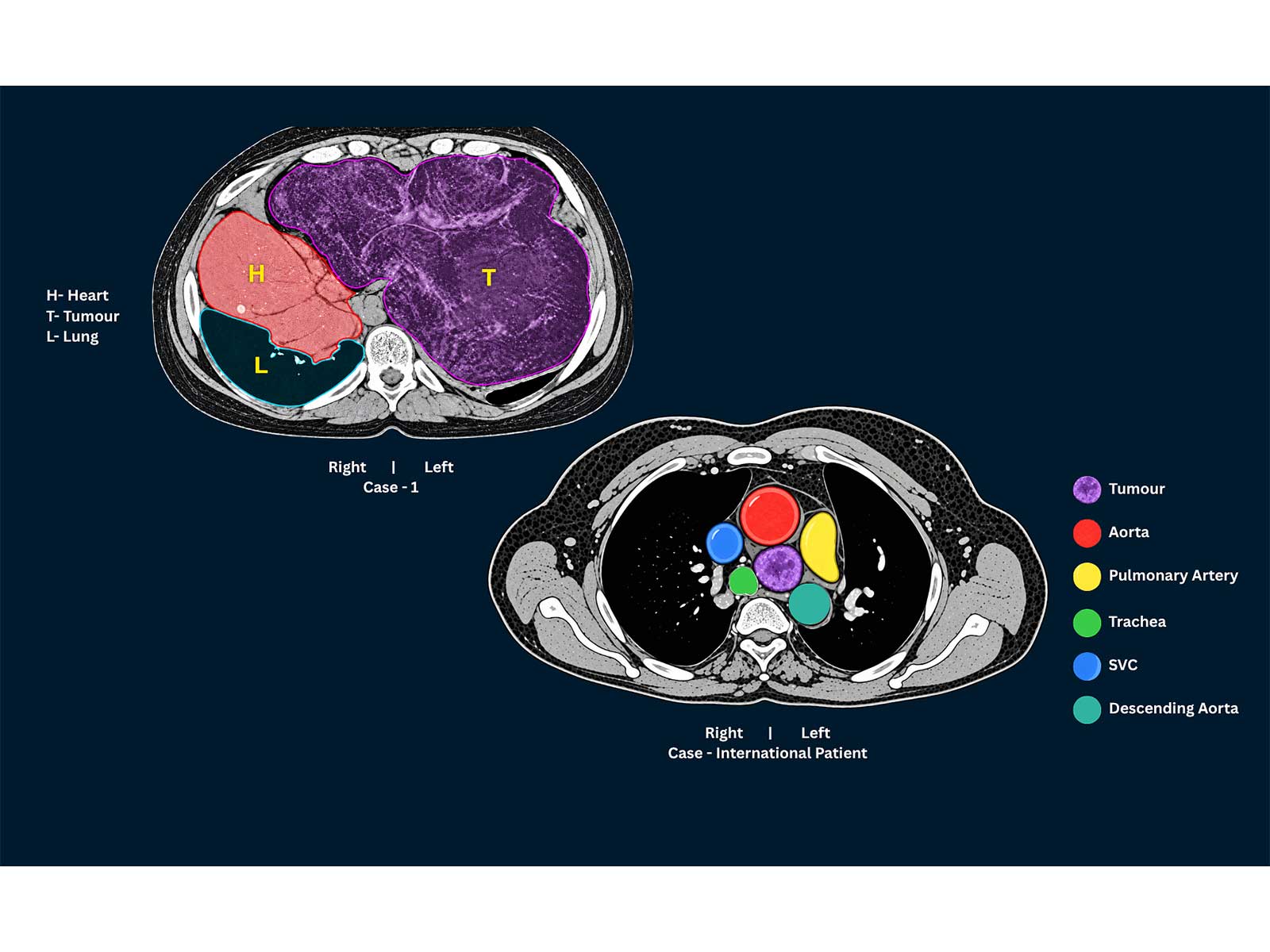
At Zydus, they did a 2D echocardiogram, and the results mimicked dextrocardia. Dr. Mahesh explains, as the tumour had grown to weigh 3 kgs with a margin spanning 23 cm, its sheer mechanical force compressed her entire left lung and the middle lobe of her right lung, which is why it mimicked dextrocardia (a condition in which the heart is on the right side). The remaining lung tissue was straining to compensate for the deflated portions, which eventually gave way and tiny air sacs ruptured under pressure that caused bleeding inside her lung and blood in her sputum. The tumour also displaced her diaphragm and, with it, her heart. Her inferior vena cava (IVC), the large vein that carries blood from the lower body back to the heart, was compressed so the blood began backing up and putting pressure on her liver (which drains into the IVC) which grew congested and enlarged with time. The vein widened below the point of compression. "Operating this close to the heart was tricky; and manipulating the tumour could result in further displacement or trigger an arrhythmia so our team kept a defibrillator on standby throughout the procedure, ready for emergency cardioversion (an urgent procedure that restores normal heart rhythm)," Dr. Mahesh said. As the tumour adhered to a lot of structures, it had to be excised carefully to avoid any other complications.
He adds, "We used a clamshell incision to gain enough room to work around the tumour without compressing the heart further or damaging any crucial organs". These clamshell incisions run across the chest and are about 30cm wide, giving a full view of the operating region. After 3 hours of thoracic surgery, the tumour was carefully mobilised and guided leftward along a plane that allowed it to be removed completely. As soon as the pressure lifted, her lungs reinflated. In the days that followed, her heart slowly drifted back towards its normal position, and she was discharged within a week. She regained her stamina and symptoms gradually returned to normal. "The final reports indicated that the 3kg mass was, in fact, a lipoblastoma," said Dr. Mahesh. Lipoblastoma is a rare, benign tumour composed of immature fat tissues. The largest reported thoracic lipoblastoma ever removed weighed 0.9kg.
Though these cases are rare, incidentally there was another patient who was also referred to Dr. Mahesh in the past. He was an 11-year-old boy who was rushed to the Zydus emergency with a mediastinal germ-cell tumour in his chest, spanning 22 cm. He was in a dire state and had to be put on ventilator support. Germ-cell tumours are best known for arising in the reproductive organs but they occasionally develop instead in the mediastinum (the narrow space between the lungs that also houses the heart, major vessels, and airway). Germ-cell tumours usually require chemotherapy before surgery. "After chemo, the tumour markers became normal although its size remained the same. Location and the size of his tumour made his case extremely complex to operate. Here too, we used a clamshell incision to completely resect the tumour," he added. The boy's condition eventually got better and he was discharged within a few weeks. He remains cancer free till date.
Dr. Mahesh has also built a significant body of work in robotic surgery in India. He adds, "The trade-off often works in the patient's favour as there is a smaller scar, lesser blood loss and it can offer more precision especially when the tumour's location is tricky". He has performed several complicated surgeries on international patients as well, and recalls a recent case, "An 80-year-old patient from Africa consulted me after being diagnosed with a mediastinal paraganglioma, 3cm in size. Though most tumours of this kind occur in the abdomen, his case was rare as the tumour was found in his chest wall (mediastinum), nestled right between the superior vena cava, aorta, pulmonary artery, descending aorta, and the trachea - some of the most critical structures in the chest, all within millimetres of each other." Germ cell tumours are notorious for secreting factors that shoot up the blood pressure even during surgery. The real challenge was to safely navigate the tumour that was wedged extremely close to major blood vessels and left no room for error.
Most surgeries of this kind, worldwide, have relied on a sternotomy, cutting open the breastbone for direct access. Dr. Mahesh chose to operate robotically instead, retracting the trachea and the superior vena cava to clear a safe path, then removing the tumour through an incision just 2 centimetres wide, without nicking any nearby vessels. The biggest scar was just 2 cm. Pulling it off through a less invasive approach took real surgical skill, which made careful planning essential. The patient recovered well and was discharged in a week. Only 5 such cases have ever been performed robotically worldwide, and none in India before this one.
Having performed a legion of India's firsts and anatomically complex cases, including India's first 3D-printed sternal implant, nation's first robotic resection of a segment 1 hepatocellular carcinoma (liver cancer) and tracheal resection under ECMO, some of the rarest resections involving the IVC and the abdominal aorta, managing SVC resections and chest wall reconstruction in invasive thymoma, and modified Appleby's procedure for pancreatic cancer. Dr. Mahesh has done some of the stellar work in GI, lung and thoracic onco surgeries across. Some of his extraordinary work has been compiled into a coffee table book (Surgical Marvels) and published across. To know more, visit Zydus Cancer Hospital in Ahmedabad.
(ADVERTORIAL DISCLAIMER: The above press release has been provided by PRNewswire. ANI will not be responsible in any way for the content of the same.)