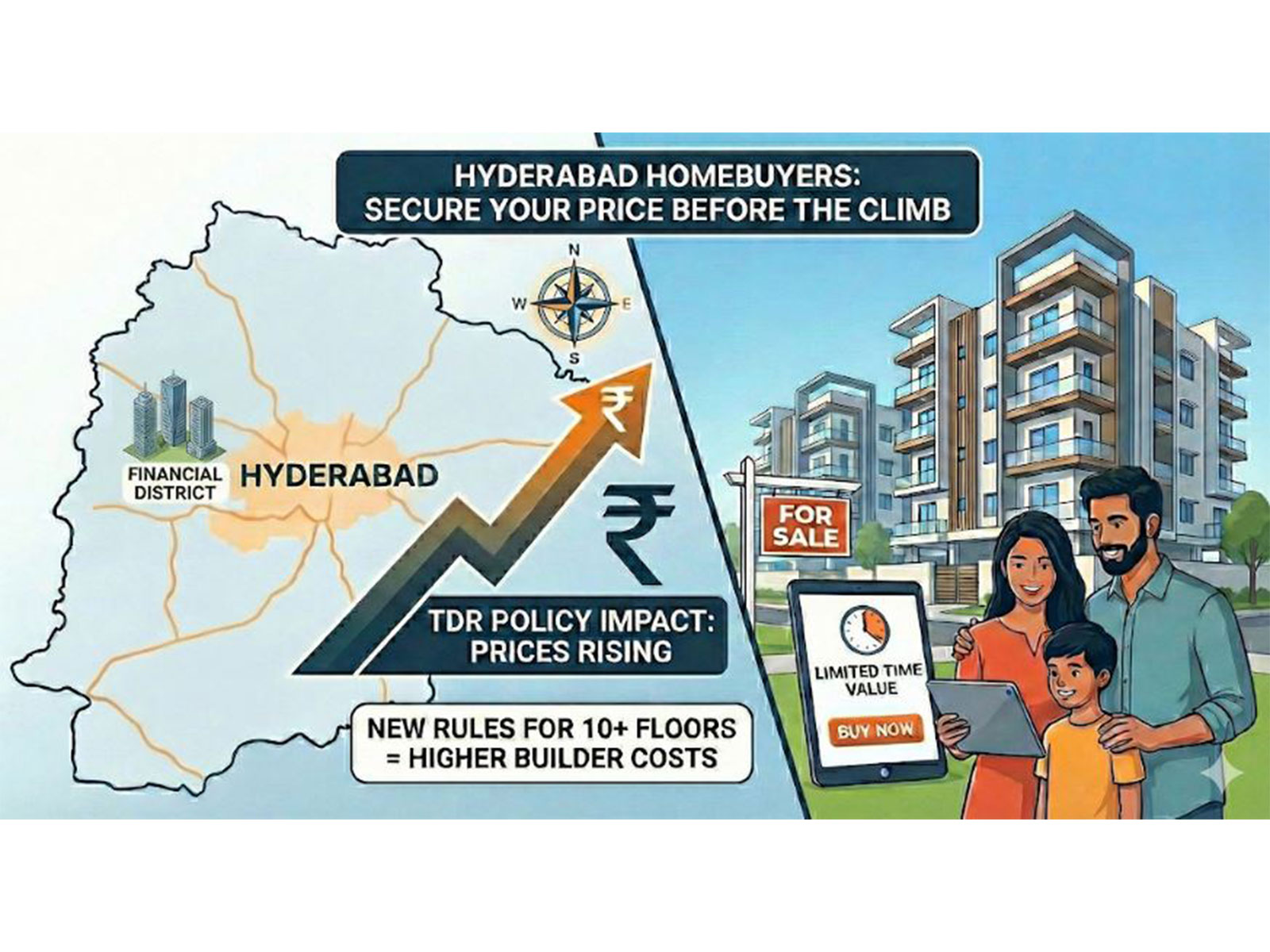
TDR Policy Explained: Why Hyderabad Homebuyers Should Buy Now Before Prices Move Up
Jan 28, 2026
NewsVoir
Hyderabad (Telangana) [India], January 28: The Telangana government has recently announced a new policy that will impact builders planning high-rise projects. Under this policy, builders will now be required to buy Transferable Development Rights (TDR) for new residential projects with 10 floors or more. But what exactly does this mean for the Hyderabad real estate market and more importantly, for homebuyers planning their purchase?
What is TDR?
Transferable Development Rights (TDR) is a planning mechanism used by the government to regulate urban growth. When the government acquires or reserves land for public purposes like roads, infrastructure corridors, or open spaces, it compensates the landowner by issuing development rights. These rights can be traded and used by builders to construct additional built-up area beyond the normally permitted limits.
Under the new Telangana policy, for residential projects above 10 floors, builders are required to purchase TDR from the government. This TDR is applicable to 10% of the total built-up area constructed above the 10th floor.
Importantly, while the policy primarily applies to new projects, ongoing projects may also fall under this rule if they seek:
- plan revisions,
- additional floors,
- extensions, or
- any fresh approvals beyond what was originally sanctioned.
In such cases, the 10% TDR loading on built-up area above the 10th floor becomes mandatory, ensuring compliance with the updated regulations during the approval or revision process.
In simple terms, the taller the building or the more changes a project seeks the higher the additional cost.
Impact of TDR on Hyderabad Real Estate Market
The new policy is expected to have varied impacts across Hyderabad's real estate market, depending on the area. On the whole, North, South, and East Hyderabad will experience limited effects, as fewer high-rise projects are being built in these areas.
However, this policy will have a direct and growing impact on new launches and revised high-rise projects, gradually influencing overall pricing benchmarks across the city.
The policy is likely to hit West Hyderabad the hardest, especially regions like the Financial District, where most high-rise development both new and under-planning, is concentrated.
West Hyderabad: The Impact of TDR
In West Hyderabad, builders are dealing with projects that average 40-50 floors. For new developments, and for ongoing projects seeking additional permissions, the TDR requirement will be particularly significant.
Builders in such cases will need to buy TDR for the upper floors (above the 10th floor), substantially increasing project costs. Over time, this additional cost pressure is expected to reflect in pricing both for future launches and ongoing projects
How We Calculated the Impact (Methodology Explained)
To understand how this policy could affect pricing, we followed a structured, data-backed approach:
- First, we identified key micro-markets across Hyderabad, with a deeper focus on West Hyderabad due to its high-rise density.
- From each micro-market, we studied multiple ongoing and planned residential projects to arrive at an approximate average built-up area per acre and the average number of floors.
- As per the policy, TDR becomes applicable only for construction above the 10th floor, and only on 10% of the total built-up area constructed above the 10th floor. Based on the average height of projects in each micro-market, we estimated the portion of built-up area that falls under this TDR requirement.
- We then applied actual TDR rates for each location, sourced from CBRE market data, to calculate the additional cost builders would need to bear per acre.
- Finally, this additional cost was translated into an approximate per-square-foot price impact, assuming that builders eventually pass on a portion of this cost to end buyers.
All numbers below are approximations, intended to show directional impact rather than exact pricing.
Estimated TDR Impact by Micro-Market (West Hyderabad)
The estimated TDR impact across West Hyderabad's key micro-markets shows notable variation in both land cost and price implications. The following data outlines the approximate additional cost per acre and corresponding price impact per square foot for each location:
- Kokapet: Additional cost of Rs. 6-7 crore per acre; price impact of Rs. 120-140 per sq. ft.
- Narsingi: Additional cost of Rs. 4-5 crore per acre; price impact of Rs. 100-120 per sq. ft.
- Rajendra Nagar: Additional cost of Rs. 2-2.5 crore per acre; price impact of Rs. 70-90 per sq. ft.
- Nanakramguda: Additional cost of Rs. 15-16 crore per acre; price impact of Rs. 380-420 per sq. ft.
- Nallagandla: Additional cost of Rs. 4.5-5 crore per acre; price impact of Rs. 130-150 per sq. ft.
- Miyapur: Additional cost of Rs. 5.5-6 crore per acre; price impact of Rs. 180-210 per sq. ft.
- Kollur: Additional cost of Rs. 1.2-1.5 crore per acre; price impact of Rs. 35-45 per sq. ft.
- Tellapur: Additional cost of Rs. 4-4.5 crore per acre; price impact of Rs. 120-135 per sq. ft.
- Kukatpally: Additional cost of Rs. 6-6.5 crore per acre; price impact of Rs. 200-230 per sq. ft.
- Neopolis: Additional cost of Rs. 6-6.5 crore per acre; price impact of Rs. 120-140 per sq. ft.
What This Means for Buyers
The takeaway here is simple: TDR costs will increasingly affect future supply.
New launches will factor this cost upfront
Ongoing projects that seek revisions or expansion will also face higher costs
Over time, this will push up benchmark prices across micro-markets
For buyers who are waiting for new launches or later phases, this creates a clear consideration. Buying into existing or already-approved projects today may offer better value, as future supply is likely to enter the market at higher price points due to TDR loading.
Why West Hyderabad is still a Prime Investment Hub
West Hyderabad, particularly the Financial District, is poised to be the epicenter of Hyderabad's real estate growth. This area already boasts major IT hubs and an influx of multinational companies. Google, Amazon, and Microsoft are setting up their India campuses here, and this region is expected to generate up to 1 lakh job opportunities in the next few years. Rental yields in the Financial District are currently between 4-5%, with the average rent for a 3BHK touching Rs. 80-85K per month. According to Magicbricks' rental report, rents in the Financial District have grown at a rate of ~18% year-on-year, and over the next five years, they are projected to increase to Rs. 1.5-2 lakh per month.
In conclusion, the TDR policy will undoubtedly lead to higher costs for builders, which will be passed on to buyers. West Hyderabad, with its growing infrastructure and connectivity, remains a prime investment destination in the city.
So, for homebuyers and investors, the message is clear: projects that already have approvals in place offer a time-bound value advantage, while waiting for future launches could mean paying more for the same micro-market.
(ADVERTORIAL DISCLAIMER: The above press release has been provided by NewsVoir. ANI will not be responsible in any way for the content of the same.)